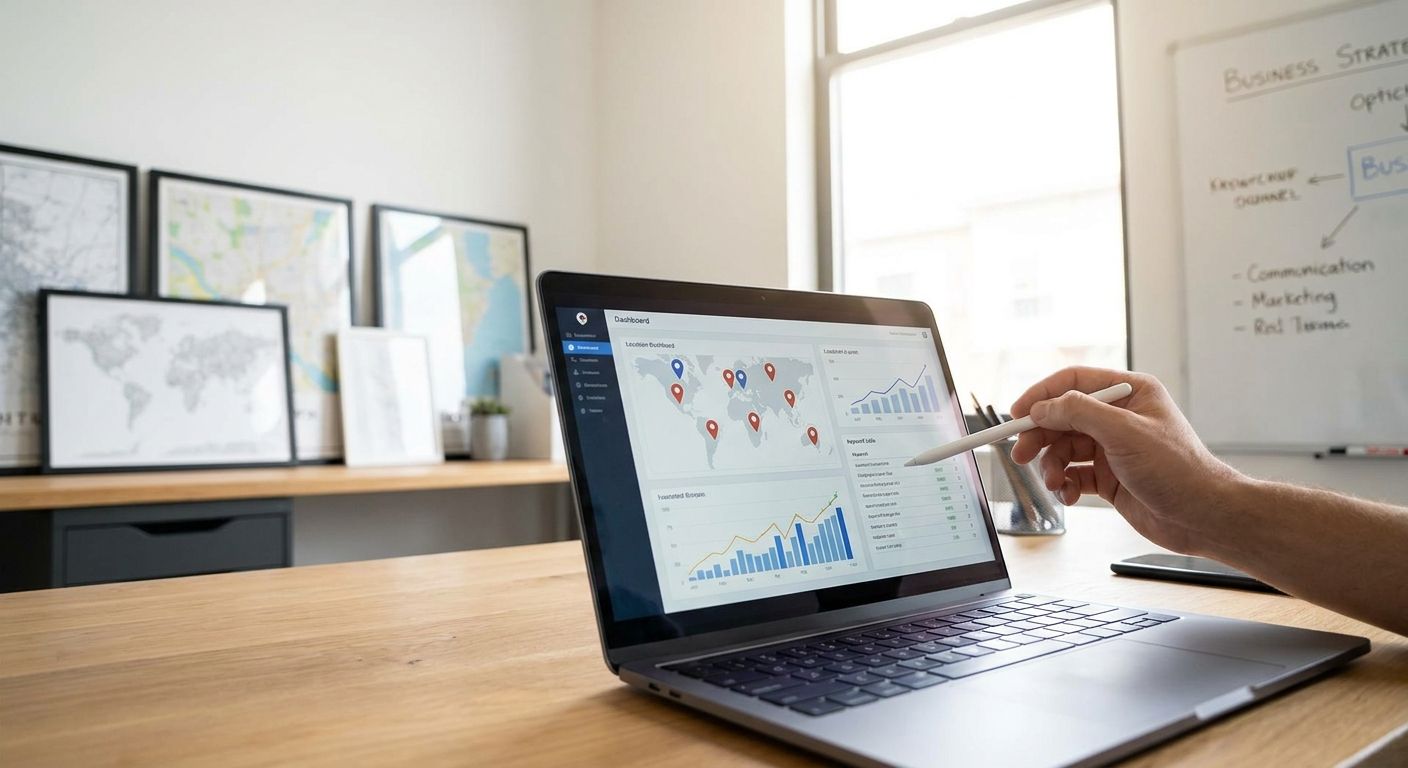
Rank tracking for franchise businesses means monitoring keyword and local pack positions for every individual location, not one blended average for the corporate domain, so a brand catches which markets are losing search visibility before it shows up in call volume or foot traffic. A single-location business tracks one set of rankings; a franchise with locations in a dozen or a hundred cities needs a system that separates each market's performance while still rolling up to a brand-wide view.
- Rank tracking for franchise businesses means per-location tracking, not one blended average, and Alef's multi-location rank tracker does this in a single dashboard.
- Franchises need separate tracking for organic rank, the local three-pack, and AI answer engine mentions in 2026.
- Manual spreadsheet tracking works for a handful of locations; past 10-15 it stops scaling.
- Keyword cannibalization between nearby franchise locations is one of the most common SEO problems in 2026.
- Franchisee-level reporting keeps local owners accountable for their own search performance instead of hiding behind the brand average.
Why rank tracking matters for franchise businesses
A franchise brand can rank #1 nationally in aggregate reporting while three of its busiest markets have quietly dropped out of the local pack. Corporate-level dashboards hide this because they average performance across every location, and the rank tracker for multi-location brands approach exists specifically to stop that blending from masking location-level losses.
Franchise SEO also has a structural risk that single-location businesses don't: cannibalization. When two locations 15 miles apart both publish near-identical location pages targeting the same city-plus-service keyword, Google splits ranking signal between them instead of boosting either one. Tracking rank by location surfaces this before it costs both stores visibility.
In 2026, the tracking job also expanded past Google. AI answer engines now field a meaningful share of "best [service] near me" queries, and a franchise location invisible in Google's local three-pack can still be named by ChatGPT or Perplexity, or vice versa. Both need separate monitoring.
How to build a rank tracking system for franchise businesses
Segment your keyword set by location
Start by building a keyword list per location rather than one brand-wide list. A single "[service] near me" keyword tells you nothing about which of 40 locations is winning or losing.
- Pair every head keyword with the city and neighborhood name for each location
- Filter Google Search Console by page URL to isolate queries per location page
- Track branded queries ("[franchise name] + city") separately from generic service queries
- Exclude corporate-only keywords (careers, franchising, investor terms) from location-level reports
- Flag keywords two or more locations are both targeting for a cannibalization check
Track local pack and organic rank separately
Google's local pack typically shows three businesses above the ten organic results on page one, and a location can win one and lose the other. Tracking them as a single blended number hides which lever actually needs fixing.
- Check local pack position in an incognito window from each location's zip code
- Log organic position for the same keyword set independently
- Monitor the Google Business Profile primary category for drift after any edit
- Watch for map pack volatility in the days after a confirmed Google update
- Compare local pack presence against the two or three nearest competing locations
This is manual and workable for five or six locations. Past that, checking each zip code by hand every week stops being realistic, which is the exact gap a dedicated local service rank tracking setup is built to close.
Monitor AI answer engine visibility per market
Organic rank and local pack position don't tell you whether ChatGPT or Perplexity names a location when someone asks for a recommendation in that city. That's a separate check, and it needs to run on the same cadence as traditional rank checks.
- Ask each AI assistant "best [category] in [city]" once a month per major market
- Log whether the franchise brand is named at all, and where it ranks among the answer
- Note which sources the assistant cites when it does mention the brand
- Track this against the same location list used for organic and local pack tracking
The process for doing this consistently is covered step by step in how to track your brand's visibility in ChatGPT and Perplexity, and the same logic applies whether it's one storefront or 200.
Set brand-wide and location-level benchmarks
A franchise needs two benchmarks running at once: a system-wide target and a per-location target, because a location in a competitive metro market and one in a low-competition town shouldn't be judged against the same bar.
- Set a target rank range per location tier based on local competition density
- Flag any location that falls below its tier's floor for two consecutive checks
- Compare month-over-month movement, not just a single snapshot
- Weight underperforming locations by estimated search volume, not just rank position
Audit each location's site health
Rank drops often trace back to a technical issue on the location page itself: a broken schema markup, a slow load time, or a duplicate title tag copied across ten location URLs.
- Check that every location page has a unique title tag and meta description
- Confirm LocalBusiness schema is present and matches the Google Business Profile
- Test page load speed on mobile for each location page, not just the homepage
- Check for duplicate or near-duplicate body content across nearby location pages
See every location's rank in one view
Track organic, local pack, and AI-search visibility by location, not a blended average.
Report rankings back to individual franchisees
Franchisees who never see their own location's search data have no reason to fix a thin location page or an outdated Google Business Profile. Reporting has to reach them directly, not just corporate marketing.
- Export a monthly one-page scorecard per location showing rank, local pack, and AI mentions
- Benchmark each franchisee's numbers against the system-wide average
- Flag the specific pages or listings that need franchisee action
- Loop in the agency or team managing paid and organic together where one exists
Many franchise systems hand this reporting to an outside team, and marketing agencies managing franchise SEO need the same per-location breakdown corporate marketing does, just packaged for client-facing reports.
Watch for keyword cannibalization between locations
This is the mistake unique to multi-location brands. Two location pages competing for the same search term don't help each other rank higher; they split the same authority and both lose.
- Map which locations share overlapping service radii
- Check if two nearby location pages target the identical primary keyword
- Differentiate page content by neighborhood, not just swap the city name
- Use canonical tags only where content is genuinely duplicate, never to hide a real cannibalization problem
Rank tracking options compared
| Option | Best for | Key limitation |
|---|---|---|
| Manual spreadsheet + Search Console | A brand with 1-5 locations | Doesn't scale past a handful of markets; no AI-search tracking |
| Single-location rank trackers | One storefront checking its own rank | No cross-location rollup or franchisee-level reporting |
| Manual AI assistant checks | Spot-checking one or two flagship markets | Time-intensive to run consistently across many cities |
| Alef's rank tracker for multi-location brands | Franchises with 10+ locations needing one dashboard | Requires connecting each location's data source to set up |
A franchise brand tracking rank as one blended average will always look healthier on paper than it performs in its worst three markets. Tracking by location is the only way to see that gap in 2026.
Common mistakes franchise businesses make
- Reporting one brand-wide rank number instead of per-location data, which hides which markets are actually losing visibility
- Letting two nearby locations target the same keyword, splitting ranking authority between them instead of building either one up
- Tracking Google rank only, skipping AI answer engine visibility even as more "near me" queries route through assistants in 2026
- Never sharing rank data with franchisees, so the people closest to the Google Business Profile have no reason to fix it
- Copying location page content across cities with only the city name changed, which reads as duplicate content to Google and to AI crawlers alike
FAQ
What is rank tracking for franchise businesses?
Rank tracking for franchise businesses is the practice of monitoring keyword rankings, local pack position, and AI answer engine mentions separately for each franchise location rather than one blended brand average. It lets corporate marketing and individual franchisees see which specific markets are gaining or losing search visibility.
How is franchise rank tracking different from single-location SEO tracking?
Franchise rank tracking has to segment data by location and roll it up to a brand view, while single-location tracking only ever needs one set of numbers. Franchises also face keyword cannibalization risk between nearby locations that a single-location business never encounters.
Should each franchise location have its own keyword rankings tracked?
Yes, every location needs its own keyword list tied to its city and service area. A brand-wide average hides which specific locations are underperforming until the drop already shows up in leads.
How often should franchise rankings be checked?
Weekly for organic and local pack rank is standard practice, with AI answer engine checks run at least monthly per market. Locations flagged below their target for two consecutive checks need immediate review.
Does AI answer engine visibility matter for franchise businesses in 2026?
Yes, ChatGPT and Perplexity now field a meaningful share of local recommendation queries in 2026, and a location can be invisible there even while it holds a strong Google local pack position. Both need to be tracked, not just one.
What causes keyword cannibalization between franchise locations?
Cannibalization happens when two nearby franchise location pages target the identical city-plus-service keyword, splitting Google's ranking signal between them instead of boosting either one. Differentiating content by neighborhood and service area, not just the city name, is the fix.
Can franchisees see their own local search rankings?
They can when corporate marketing sets up per-location reporting; without it, most franchisees never see their own numbers. A monthly scorecard showing rank, local pack, and AI mentions per location keeps franchisees accountable.
What's the best rank tracking tool for franchise businesses?
The best fit for a franchise with 10 or more locations is a multi-location rank tracker built for per-location and brand-wide reporting in one dashboard, since spreadsheets and single-location tools don't scale past a handful of markets.
One last thing
Google's local pack still only shows three businesses above ten organic results on page one, but AI assistants often name just one or two when asked for a recommendation in a city. A franchise location holding a strong local pack spot in 2026 can still lose the AI-search answer entirely if nothing on its page or listing gives an assistant a reason to cite it by name. Check both, not just the one that's easier to screenshot for a franchisee report.