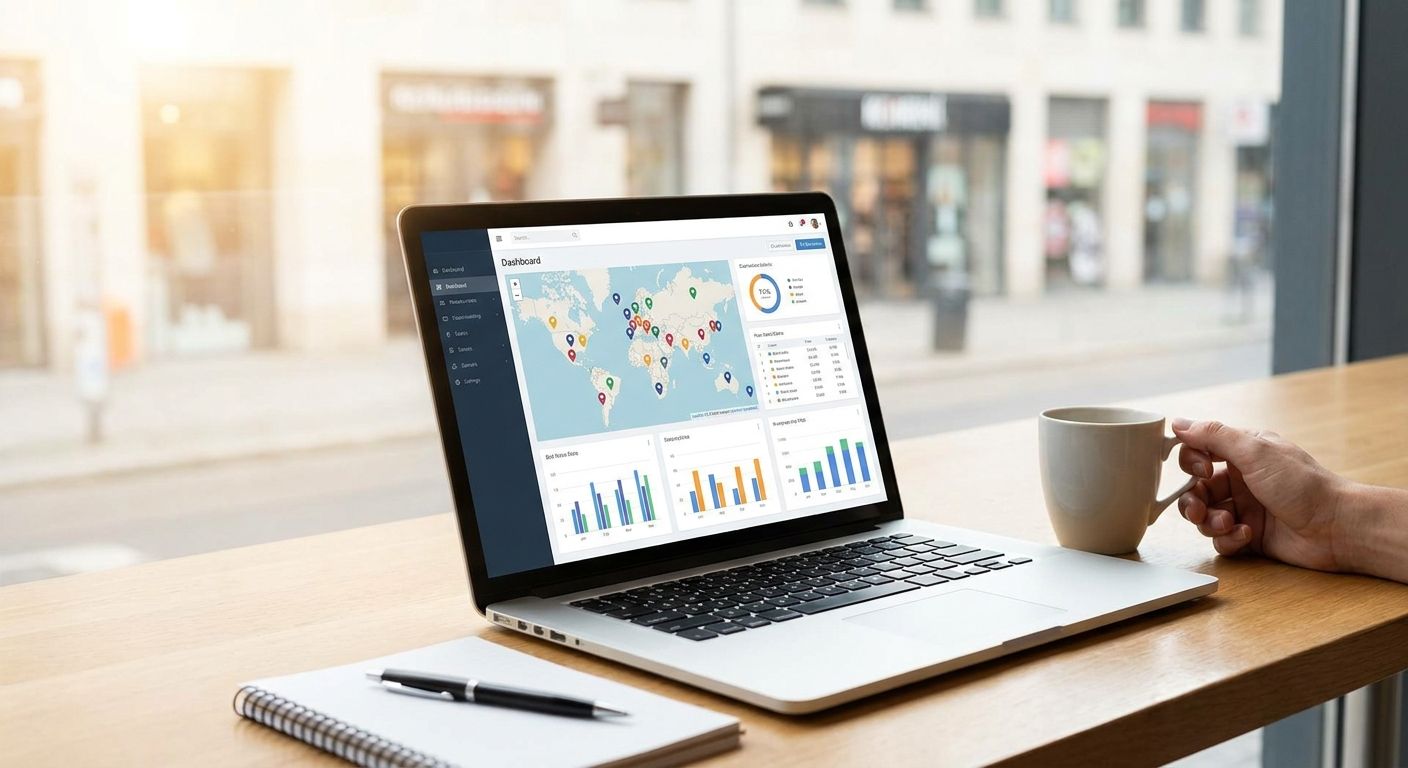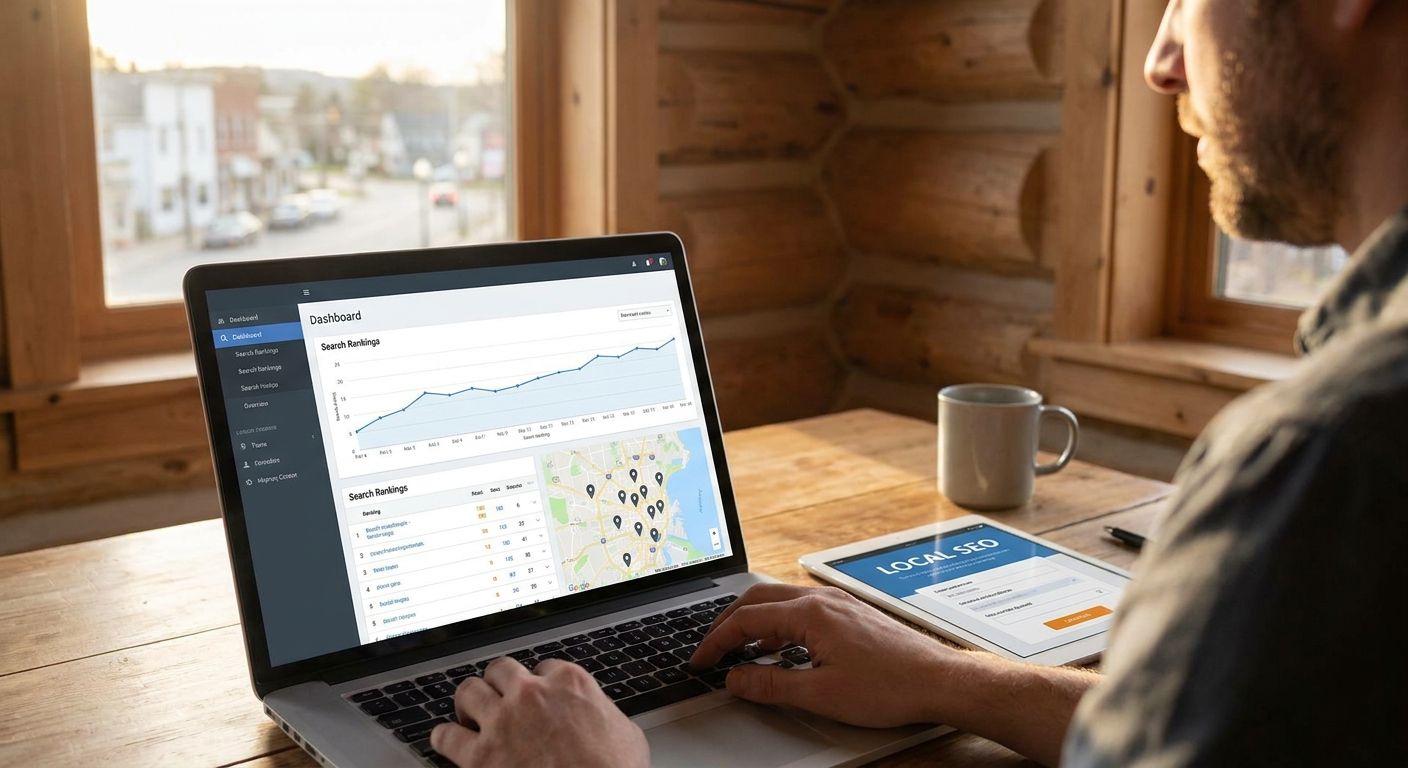
Local service business rank tracking is monitoring where your plumbing, HVAC, landscaping, or cleaning company shows up in Google's map pack, organic results, and AI answer engines like ChatGPT and Perplexity, with the aim of turning search visibility into booked jobs. Unlike ecommerce or SaaS rank tracking, this segment lives or dies on hyperlocal terms tied to a service area radius, and the Google Business Profile listing often matters as much as the organic result below it.
- A rank tracker for local service businesses must track map pack position and organic rank separately, by city.
- Manual Google searches work for one location but break down past 3-5 service areas.
- ChatGPT and Perplexity now answer local recommendation queries, and most rank trackers never check that layer.
- Alef tracks organic rank, map pack position, and AI-engine mentions in one dashboard for multi-city service businesses.
Why rank tracking matters for local service businesses
A plumber sitting at #1 in the map pack for "emergency plumber [city]" gets the call before the competitor in position 4 even opens the phone. That is the entire business case. Local service searches convert to phone calls and form fills at a rate no other category sees, because the searcher usually needs the job done today.
Most rank tracking tools were built for content sites or ecommerce catalogs tracking thousands of product keywords. Local service businesses need something narrower and deeper: 15-40 service-area keywords tracked across multiple cities, checked against both the map pack and the organic result, with competitor Google Business Profiles watched alongside your own.
2026 added a second layer. Searchers now ask ChatGPT and Perplexity "who is the best roofer near me" instead of typing it into Google, and most local service businesses have zero visibility into whether they get named in that answer.
Check your current map pack and organic position manually
Before paying for any tool, run the searches yourself. This gives you a baseline and costs nothing but time.
- Search your top 10 service keywords from a phone in incognito mode, not your office desktop
- Search each keyword paired with your 2-3 largest service-area cities separately
- Record the map pack (top 3 local results) and note your position, or note that you are absent
- Check the organic result below the map pack for the same keyword
- Repeat weekly for 4 weeks to see normal fluctuation before drawing conclusions
Map your service-area keyword list before tracking anything
Most local service businesses track too few keywords and miss the suburb and neighborhood variations that make up a large share of their search demand.
- List every service you offer combined with every city or suburb you serve
- Add "near me," "emergency," and "same day" modifiers where speed drives the decision
- Include colloquial terms customers actually type, not industry terminology
- Separate residential and commercial variants if you serve both
- Cap the list at what you can act on: 40-60 keywords is workable for a single-location business
Track map pack and organic rank as two separate metrics
Treating map pack position and organic rank as one number hides which lever to pull. A rank tracking platform separates the two automatically instead of forcing a manual spreadsheet.
- Log map pack position (1-3, or absent) separately from organic position for every keyword
- Track by individual city when you serve more than one area, since an average hides where you are losing
- Note which competitor occupies each map pack slot you do not hold
- Flag keywords where you rank organic top 3 but are absent from the map pack, which usually points to a Google Business Profile fix rather than a content fix
Monitor competitor Google Business Profiles alongside your own
Your position is relative. A competitor adding review volume or service categories can push you down a slot without anything changing on your end.
- Track review count and rating for the top 3 map pack competitors on each core keyword
- Watch for competitors adding new service categories to their profile
- Note posting frequency on competitor profiles: photos, updates, offers
- Record which competitors respond to reviews and how quickly
- Re-check monthly, since profile changes rarely announce themselves
Add AI answer engine tracking to your local visibility check
Google's map pack is no longer the only place local recommendations happen. ChatGPT, Perplexity, and AI Overviews answer "best [service] in [city]" directly, and a rank tracker for local service businesses that ignores this layer tells you half the story in 2026.
- Ask ChatGPT and Perplexity your top service-plus-city queries and log whether you are named
- Note which competitors get named instead, and in what order
- Check whether your profile description and review content match what the AI answer cites
- Automate the check rather than running queries by hand, since manual AI checks are the first task teams drop — the guide to tracking brand visibility in ChatGPT and Perplexity covers the mechanics
Set rank-drop alerts instead of checking manually every week
Manual weekly checks catch problems late. A 5-position drop that happens on a Tuesday should not wait until Monday to get noticed.
- Set alert thresholds at 3+ position drops for map pack, 5+ for organic
- Route alerts to whoever owns local SEO, not a shared inbox
- Separate alerts by service area so a drop in one city is not buried by stability in another
- Review alert history monthly to catch recurring patterns
Report rank data against call volume, not rank alone
A rank number means nothing to an owner without call volume attached. Agencies managing this for clients hit the same wall.
- Pull call tracking or lead form data for the same date range as your rank report
- Show rank position next to lead volume per keyword group, not a blended average
- Highlight keywords where rank improved but leads did not move — that is a conversion problem, not a ranking problem
- Report monthly at minimum, weekly for the first 90 days of a new local SEO push
Comparison: local rank tracking options in 2026
| Option | Best for | Key limitation |
|---|---|---|
| Manual Google searches | One location, under 10 keywords | No history, no trend data, no AI engine visibility |
| Google Business Profile Insights | Checking your own profile views and calls | No competitor data, no organic rank position |
| General-purpose SEO rank trackers | Businesses already tracking organic rank for content | Rarely separates map pack from organic, usually skips AI engines |
| Alef | Multi-city service businesses that also need AI engine visibility | Built for AI-search visibility broadly, not local-only workflows |
Pricing is not listed here because plan structures change; check current pricing on each vendor's site before comparing cost.
Track local rank across Google and AI engines
See organic rank, visibility trends, and AI engine mentions in one dashboard.
Common mistakes local service businesses make
- Tracking only "near me" keywords and skipping the service-plus-city terms that carry stronger intent
- Averaging rank across service areas, which hides the one city that is actually losing ground
- Watching organic position only and ignoring the map pack, even though the map pack takes most mobile local clicks
- Never checking AI answer engines, leaving a growing share of "best [service] near me" queries invisible
- Reporting rank without call volume, which makes it impossible to prove a ranking gain produced revenue
FAQ
What is the best rank tracker for local service businesses in 2026?
The best option tracks map pack position, organic rank, and AI answer engine visibility per service-area city rather than one blended average. Alef covers organic rank and AI engine mentions in one dashboard, while most general SEO trackers cover organic rank only.
How is local rank tracking different from regular SEO rank tracking?
Local rank tracking separates map pack position from organic position and checks results city by city instead of nationally. Regular rank tracking, built for content and ecommerce sites, usually skips the map pack layer entirely.
Do I need to track AI engines like ChatGPT for a local service business?
Yes, if customers in your area ask ChatGPT or Perplexity for a recommendation instead of searching Google. In 2026 most local service businesses have no visibility into whether they get named in those answers.
How often should I check my local search rankings?
Weekly checks catch problems early enough to act on them, and monthly reporting is the minimum for tying rank to call volume. Run weekly checks for the first 90 days of any new local SEO push.
Can I track local rankings manually for free?
Yes, for a single location with under 10 keywords, incognito searches from a phone give a reasonable read on map pack and organic position. Past 3-5 service areas or 40 keywords, manual tracking stops being reliable because you lose trend history.
Does map pack ranking matter more than organic ranking for local services?
The map pack takes most mobile local clicks for service categories, but organic rank still drives desktop traffic and feeds the citations AI engines pull from. Track both separately rather than picking one.
What keywords should a local service business track?
Combine every service you offer with every city or suburb you serve, then add speed modifiers like emergency or same day where they apply. A business with 3 services across 4 cities needs at least 12 base keywords before modifiers.
How do agencies report local rank tracking to clients?
Pair rank position with call volume or lead form data for the same date range, broken out by keyword group rather than a single average. A rank gain with flat call volume signals a conversion problem, not a ranking problem.
One last thing
A strong map pack position does not guarantee an AI citation. The two systems read different signals, so a business holding top-3 in the map pack can still be absent from ChatGPT and Perplexity answers for the same query in 2026. Check both before assuming your local search work is finished.